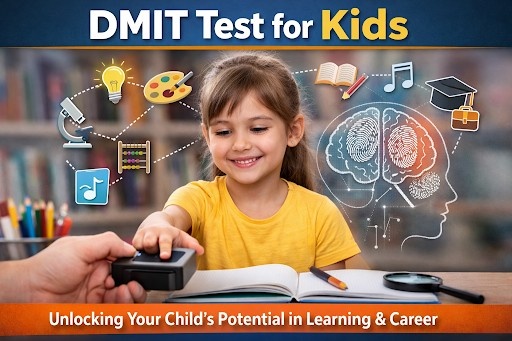
DMIT Test for Kids: How It Helps in Career & Learning Decisions
Many adults realize later in life that they chose a profession based on pressure, trends, or circumstances — not based on their true strengths. The real question for parents is: Would you want your child to grow up confused about their strengths — or confident about their direction?
What Is a DMIT Test for Kids?
The Dermatoglyphics Multiple Intelligence Test (DMIT) is a guidance-based assessment that studies fingerprint patterns to understand a child’s natural tendencies.
Fingerprints are formed before birth and remain unchanged throughout life. DMIT uses these patterns to analyze:
- Learning style
- Types of intelligence
- Natural strengths
- Behavioral tendencies
- Cognitive preferences
Important: DMIT does not predict a fixed career. It helps parents understand a child’s inborn potential.
Why Career & Learning Decisions Are Difficult Today
Many parents still follow a trial-and-error method:
- Comparing children with neighbors
- Following popular career trends
- Forcing subjects based on marks
- Assuming success equals certain professions
But every child is different. What works for one child may not work for another. Identifying strengths early reduces confusion later.
How DMIT Test Helps in Learning Decisions
Learning problems often occur not because a child lacks intelligence — but because the learning style does not match the teaching method.
DMIT helps parents understand:
- Whether a child learns best visually, auditorily, or kinesthetically
- Whether the child prefers logic-based tasks or creative expression
- Whether they process information quickly or analytically
This clarity allows parents to:
- Choose suitable activities
- Avoid unnecessary pressure
- Support weaker areas effectively
Top 7 Benefits of DMIT for Children (Aged 5–10)
1. Identifies Natural Abilities
Reveals innate strengths in areas like logic, creativity, communication, or leadership.
2. Understands Multiple Intelligences
Shows whether the child leans toward linguistic, mathematical, musical, spatial, or interpersonal intelligence.
3. Defines Learning Style
Helps parents adjust study techniques according to how the child absorbs information best.
4. Boosts Confidence
Children feel more confident when their strengths are acknowledged instead of constantly being corrected.
5. Highlights Learning Challenges
Provides insight into possible focus or comprehension difficulties.
6. Guides Parents Effectively
Parents receive structured guidance instead of guesswork.
7. Builds Strong Foundation
Early understanding leads to better academic planning and balanced personality development.
Can DMIT Predict a Child’s Career?
The honest answer is: No.
DMIT does not predict a fixed career and is not a fortune-telling tool. Instead, it identifies natural inclinations. For example:
- A child inclined toward logical intelligence may do well in analytical fields.
- A child strong in interpersonal intelligence may thrive in leadership or communication roles.
- A child with artistic intelligence may perform well in creative domains.
However, career success also depends on:
- Environment
- Education
- Practice
- Opportunities
- Personal effort
DMIT acts as a directional compass, not a final decision-maker.
Why Counselling After DMIT Is Important
The test alone is not enough. Proper counselling ensures:
- Correct interpretation of the report
- Practical implementation
- Balanced understanding of strengths and weaknesses
Is DMIT Suitable for All Children?
DMIT can be useful for:
- Young children (5–10 years) for learning clarity
- School students for subject selection
- Teenagers for stream and career direction
It should always be used as a supplementary guidance tool, not a replacement for observation and experience.
Final Thoughts for Parents
Every child is born unique. The goal is not to label children, compare them, or restrict them — the goal is to understand them better.
- Reduce unnecessary pressure
- Make informed educational decisions
- Create a supportive environment
- Encourage confidence instead of confusion
The DMIT Test for Kids is not about deciding a child’s future — it is about guiding it thoughtfully.
Frequently Asked Questions
Is DMIT safe for young children?
Yes, DMIT is completely non-invasive and safe for children. The process only involves scanning fingerprints digitally, without any physical discomfort or medical procedure. It does not involve blood tests, injections, or psychological pressure. The purpose is simply to understand natural learning patterns and strengths in a structured and harmless way.
At what age can DMIT be done?
DMIT is generally recommended from the age of 5 onwards. By this stage, fingerprints are fully developed and learning behaviors begin to show clearly. However, the test can also be done for older children and even adults. Early understanding helps parents guide their child’s development more consciously and confidently.
Does DMIT replace academic assessment?
No, DMIT does not replace school exams or academic assessments. It is designed to complement traditional learning methods. While academic tests measure performance, DMIT focuses on understanding natural abilities and learning styles. Both together can provide a more balanced picture of a child’s development.
How long does the DMIT process take?
The fingerprint scanning process typically takes around 10–15 minutes. After that, the collected data is analyzed, and a detailed report is generated. The complete process may also include a counselling session where the results are explained clearly to parents, helping them understand how to apply the insights effectively.